
Before a snake sheds its skin, its eyes go cloudy. A milky blue film slips over them, the animal goes into hiding, and for a week or so it bumps into everything, including dinner. Few people mention this awkwardness when they talk about transformation. They show you the glossy new snake and the cellophane ghost left on the ground, and skip the blind, uncomfortable stretch in between. I'm in that stretch now. After decades as a working illustrator, a career I fiercely built and was proud of, I'm turning into a full-time fine art ceramicist, and so far, from the outside, it seems as if nothing has happened at all.
This isn't my first molt. Forty years ago I ran a house-cleaning business, and for a few years, between the scrubbing and the clients, I was quietly building the portfolio for a different life. When my first freelance illustration commission came in, I closed out my cleaning clients in two weeks and jumped in with both feet. There was no reassurance then, either. There was only a knowing, the kind you can't argue yourself out of. I've been building toward this next skin for eight years in much the same way, one pot at a time, mostly in the dark. I can't see what's under that skin, but I recognize the cloudy eyes.
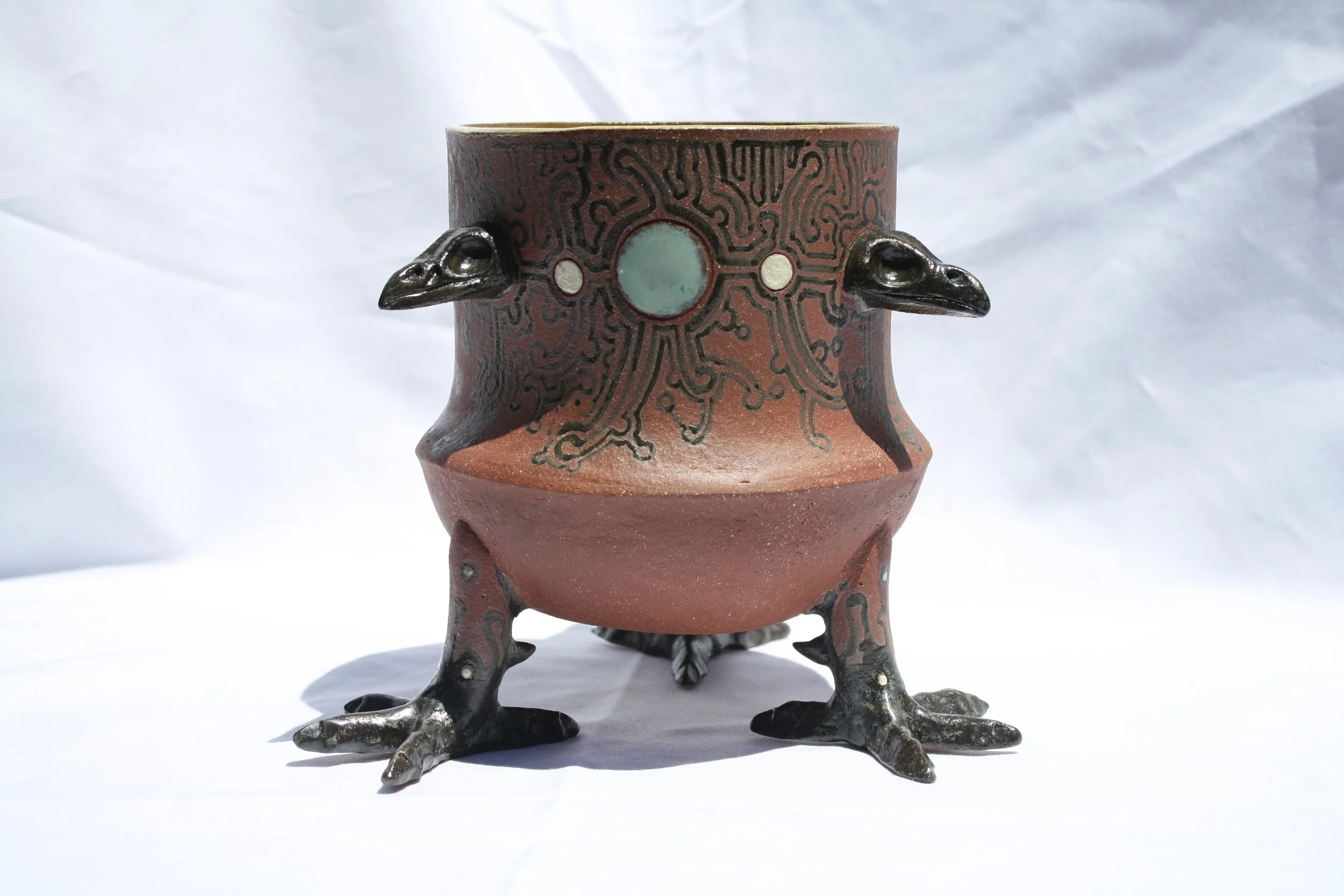
I keep field guides in various forms. Some are paperbacks swollen from being dropped in creek beds, and some are goddesses. The one I've leaned on lately is Hecate, goddess of crossroads and thresholds, torch-bearer, the bearer of three faces. I met her years before I needed her. A few years ago I made a cauldron with three bird legs, three skeletal bird heads, and my first tentative sigil markings, a vessel built for the business of transformation. At this crossroads, she walks a few steps behind me. I can't see her, but I apprehend my own shadow stretching out ahead of me. It's the only map I have. Nobody chooses the liminal space. It isn't a decision so much as a season, like the cold dark a seed has to sit through. But it does its work: it strips away what isn't necessary and makes room for what is.
Lately I've been shedding in the literal sense, too. I've packed up old artwork, let go of clothes that stopped fitting, and carried out the collections, objects, and books that belonged to a different version of myself. The tons of art tomes I used for teaching. The seashell collection with the Murex shell I painted five times. A drafting table I owned from when I was eight years old and stopped using a few decades ago. A snake leaves its old skin behind whole, an intact sleeve in the exact shape of the animal, down to the wee clear caps that covered the eyes. The scientific word for it is exuviae, and I've been making ginormous piles of it. I'm not going to pretend the snake is braver than I am; I handled each piece before I let it go, because it was me once, and it did its job. But the studio is quieter now. There's space on the shelves, on the floor, and somewhere behind my eyes, where the new person needs room to unfold.
Leaving behind a version of my career that no longer reflects who I am or what I make is hard. But I have something to look forward to that I can't quite see yet, which is a strange thing to say with cloudy eyes.
Here's the part the snake can't help me with: I don't leave everything behind me. Forty years of drawing came with me. So did the habit of staring at a flower or a beetle until I can see how the parts work, and the philosophy that guides my hands before they touch clay. Illustration taught me to sit with what the art director is telling me, to distill it, and hand them something they didn't know they wanted. I now bring that full arsenal, a lifetime of trained perception and diplomatic genius, to bear on the weighty question of whether a vessel is moody or merely sulking. Nobody has ever art-directed one of my pots, and I know why: the pot is the art director. Its notes are structural, and its verdicts come down to proportion, weight, and whether the details let it do its job. It has been tapping its foot for years and has lately taken to beating me with wet noodles.
What's changed is the order of operations. In illustration, the specs came first and the work answered them. Now I make the work first and find out afterward whether it fits anyone's decor. No client is waiting with a brief. I traded noise I couldn't choose for noise I can. The art director who said "this isn't working" is gone, and so is the deadline, but so is the person who says "finish." So I'm building my own scaffolding: deadlines I set myself, a few critics I actually trust, a body of work big enough to lean on. When you step outside the labels you can become anything, but a curator still needs a handle to pick you up by, so I'm forging my own: a naturalist's attention, an appetite for myth, and the vessel.
If you're an artist at any place in your journey, this may happen to you. Not an ending, exactly, but a molt. Watch where the joy goes, because it often knows before you do. Don't mistake outgrowing a career for failing at it. And expect cloudy eyes. Bump into the furniture if you have to. Just keep slithering.