
What Are You Actually Buying?
Ask most people why they went to college and you'll get an answer shaped like a hope rather than a goal: it would open doors, it would put them near the right people, it would signal to the world that they were employable. Mom and Dad said it was for the best. The job fairs would happen. The connections would form. Somewhere in there, ideally, they'd also end up loving — or at least tolerating — whatever field they landed in.
Artists are usually a little further along than that. Most of us arrive already knowing our genre, already half-formed in our obsessions. But knowing what kind of art you want to make is not the same as knowing what you need from a school in order to make it. And nobody ever asks that question cleanly enough for most students to answer it.
So let's ask it properly: not "is art school worth it," but what are you actually buying?
Because school sells several genuinely different things, and they are not interchangeable.
The first purchase: a peer group that tells you the truth
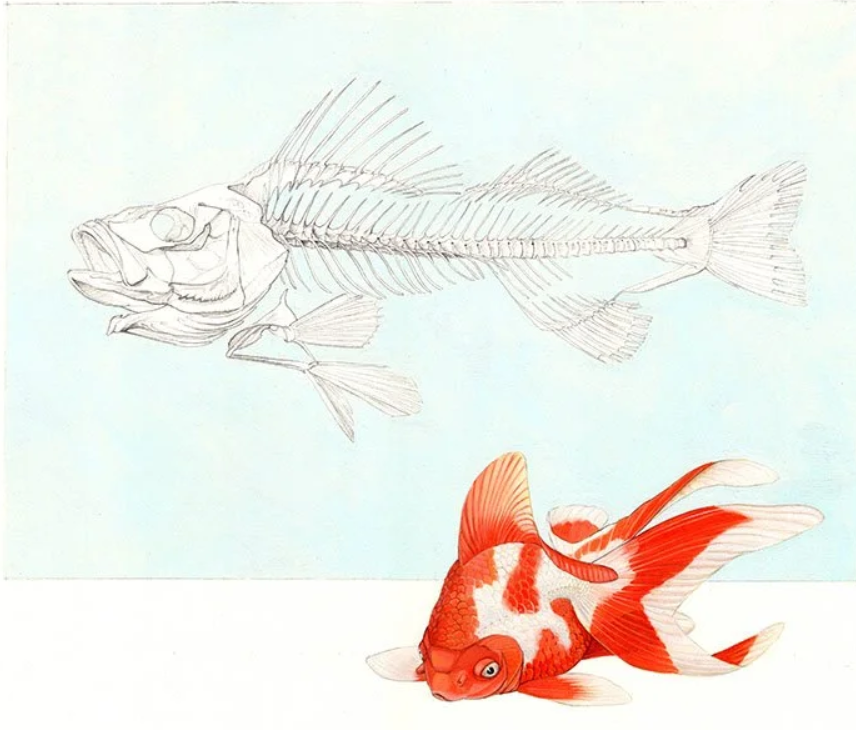
If you were any good as a kid, you were probably the biggest fish in a very small bowl — the best artist in your high school, maybe the best anyone in your town had seen in years. That's not arrogance. It's just math. A goldfish bowl has no ocean in it. You can't discover how small you actually are until you're swimming somewhere with enough room to find out.
This is one of the quieter things school buys you: an accurate read on your own ability, delivered by the only mechanism that can actually deliver it — a room full of people working at your level or above it.
But it doesn't always work the way you'd expect. I went to a small, technically focused art school right out of high school — not top-tier, but dedicated, with a degree-granting relationship to a local college. My goal was speed: get into the field as fast as possible. The dropout rate was brutal — of a hundred students who started the year, fifty remained by the next semester, and the attrition kept compounding from there. I didn't graduate either. I got hired as a ghost painter for a local illustrator and left during my last semester, because by then I already knew I didn't need the degree to do the work.
But the best thing that school gave me wasn't technique, although I got plenty of that. It was Mark.
Mark was a fellow student at that same school, and here's the complication to the goldfish story: he wasn't a guppy who needed the ocean. He arrived already heads and shoulders above even our instructors, in vision if not yet fully in technique. The school still moved him forward — technical floors are still floors, even for someone standing on his toes — but what actually mattered was that he and I found each other in that water. We kicked each other in the pants for years afterward. (We still kind’ve do.) That kind of peer isn't a guppy and isn't an ocean. He's a tank-mate, swimming in a similar pace, and finding one might be the single best argument for being in a room with other artists at all — regardless of what the room is technically teaching you.
The second purchase: a context big enough to hold your work
The second time I went to school, I was trying to leave art behind entirely. I was burned out, and I thought what I actually wanted was a biology degree and a research job. I got all my credits transferred, took everything except art classes, minored in Feminist Thought, took Biology with an emphasis in Botany — and ended up, by graduation, with a mature body of "fine art" work I hadn't set out to make.
What that experience actually sold me was context. Art doesn't get made in a vacuum; it needs real fascination anchors rooted in the actual world. Learning how culture gets constructed through a feminist lens turned out to function exactly like learning genetics or evolution — both are systems of thought, and once you have a system, you stop accumulating random facts and start understanding how the world fits together. I came out of that not as a biologist, but as someone who saw the world definitively as an artist, with a portfolio strong enough to get into grad school and a fledgling fluency in theory that let me explain why the work looked the way it did.
This is the purchase nobody knows they're shopping for. You don't go looking for context. You go looking for something else entirely, and the context is what's waiting for you when you arrive.
The third purchase: a renewable process
Grad school was a different kind of transaction altogether. By the time I got there, I already had skills, already had clients, already had a college teaching position. What I needed wasn't more technique. I needed to learn how to keep becoming someone new, indefinitely, on purpose.
That program exposed me to postmodern thought and contemporary practice that challenged me severely, and the difficulty wasn't really the grueling hours — the painting, the drawing, the essays, four years of concentrated summer terms. It was the speed of the demolition. My art practice, stuck in old patterns, got broken down, melted, and re-formed in a span of time my brain wasn't fully ready to process. It felt, often, like my mentors were trying to tear my old skills away — but what they were actually doing was loosening my thinking enough to let new skills in, the kind that would make the whole practice sustainable rather than just impressive.
Sustainability was the real gift. Not a finished style, but the ability to tear down my own thinking — my work, my process, my stale angle on something — and rebuild it, any time I needed to, for the rest of my life. (Learning to trust that rebuilding process — rather than fear it — is its own skill, one I've written about [here].)The program also taught me to tolerate ambiguity, to let meaning stay open rather than demanding it lock into place too soon.
And the four years of that — the tears, the frustration, the failures, the breakthroughs — produced something I didn't fully expect going in: some of the most enduring friendships of my life. The relationships that came out of that particular crucible cannot be overstated. We grew exponentially together because we were suffering and building at the same time, in the same room, watching each other do it.
So: which one are you buying?
None of these purchases involves the word "worth." Worth is the wrong axis entirely — you can't weigh a transaction against a goal you never named. The real question is which, and the honest answer is that most people don't buy the wrong thing because they're foolish. They buy the wrong thing because nobody ever asked them, clearly, what they were actually short on. Knowing what you're short on, in the end, comes back to the same muscle as trusting your own instincts in the studio — it's a kind of self-knowledge nobody else can hand you.
Maybe you need a tank full of people who'll tell you the truth about where you stand. Maybe you need a context wide enough to hold work you don't know how to make yet. Maybe you've already got the skills and the context, and what you actually need is a crucible — and the particular, unrepeatable friendships that only get forged inside one.
Figure out which purchase you're making before you make it. The school can't tell you. Only you can.