
A provenance note on the name, the cartouche, and their evolution
I. The cartouche
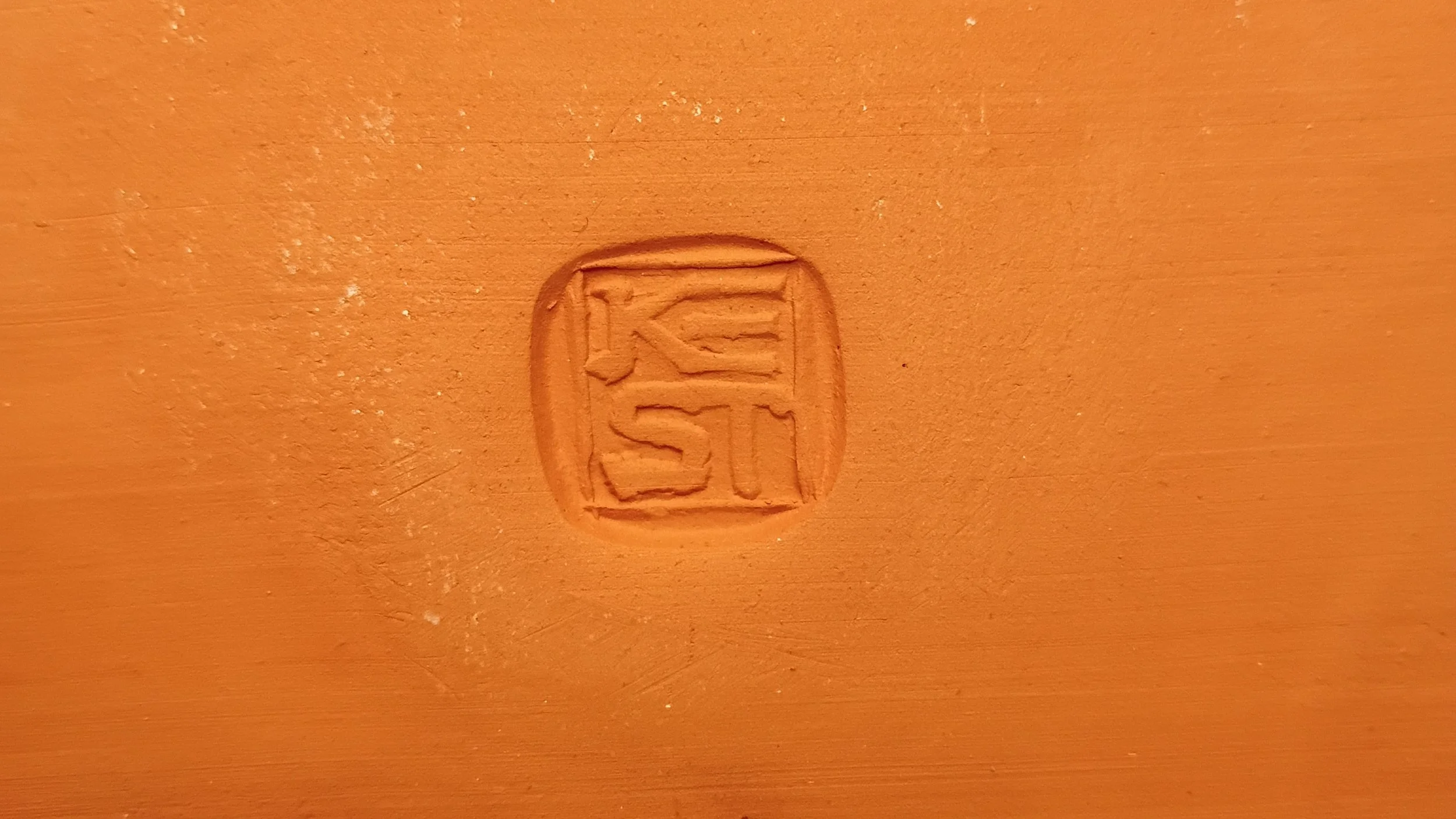
Originally, the pharaoh's name was enclosed in an oval — a cartouche meant to encircle and protect the divine king's identity for eternity. Mine has a simpler meaning. The square cartouche of KEST that appears on my pottery and on my paintings mainly highlights the object's handmade quality. A human made this thing. One person, with a name.
You may be curious when and why that name changed. I was always the person who was going to change her name — I knew it from the time I was in my single digits. My father's family name was old world, difficult to pronounce, more difficult still to spell, and I had tired of explaining it over and over across every phone call and transaction that required it. Kest is easier — to say, to spell — and it has a snappiness that I always enjoyed in short last names.
At age 19, I walked into an attorney's office with a check for $400. Three months later, my name was changed in court. I had the middle name struck as well. Such audacity.
I didn’t tell my father's family beforehand. My mother thought I should. But I was over 18, paying my own way through art school, working a full-time factory job, owning a vehicle, renting an apartment — fully adulting, as one might say now. In 1988, a person could actually afford to do all of that simultaneously, which tells you something about both the economy and my stubbornness.
II. The evolution of the mark
Before any published books, long before any pottery or sculptural work came into being, my original mark was a simple script signature: Kest. When I began working as a freelance illustrator, it was cleaner to develop a proper cartouche — two K's set back-to-back inside a rectangle. All straight lines, easy to render cleanly on book covers and fine art pieces. Thirty children's books and several years into a boutique pottery practice, I was still using that mark.
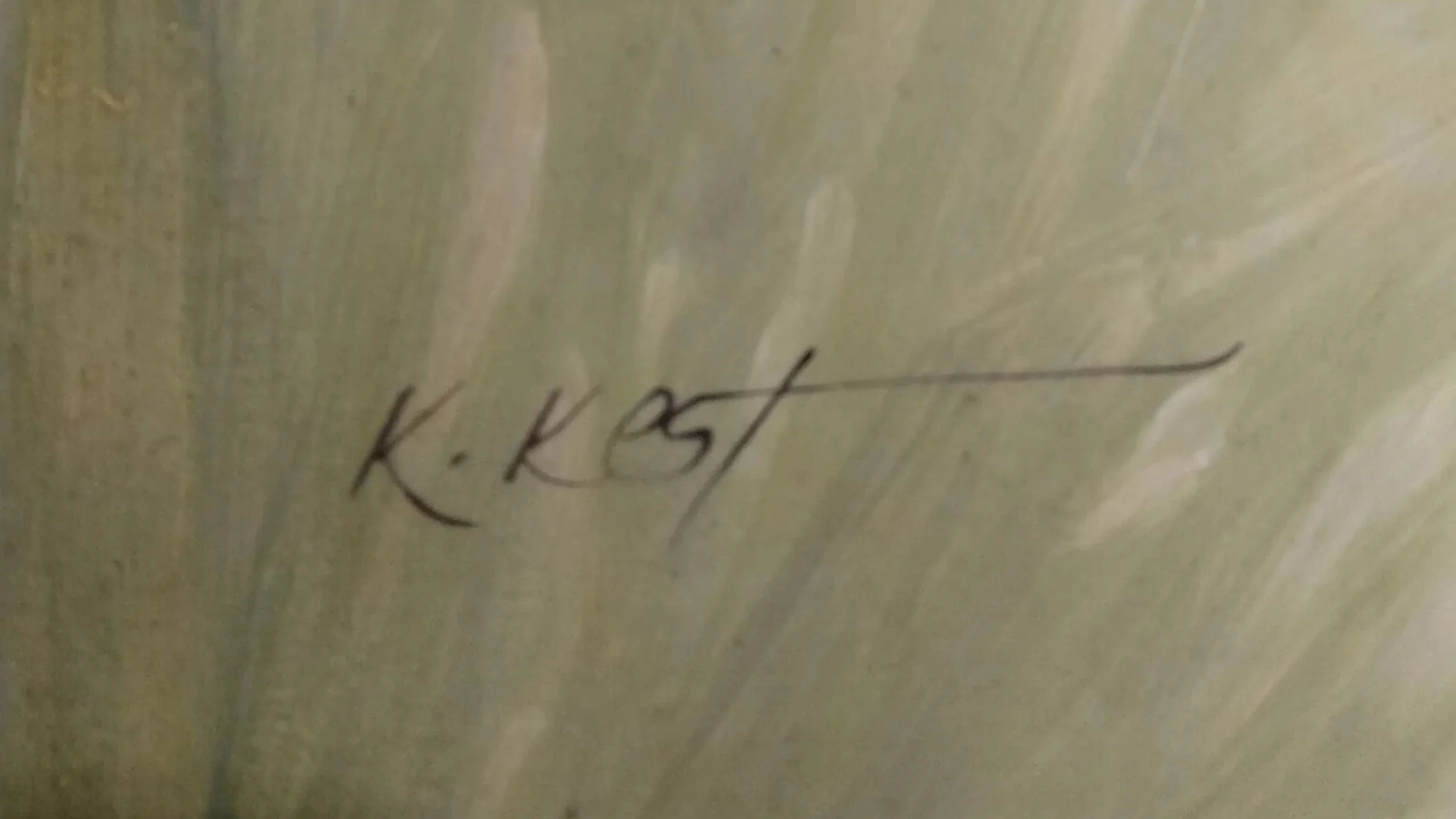
The earliest signature I can find with Kest on it is on this painting, Thumbelina.
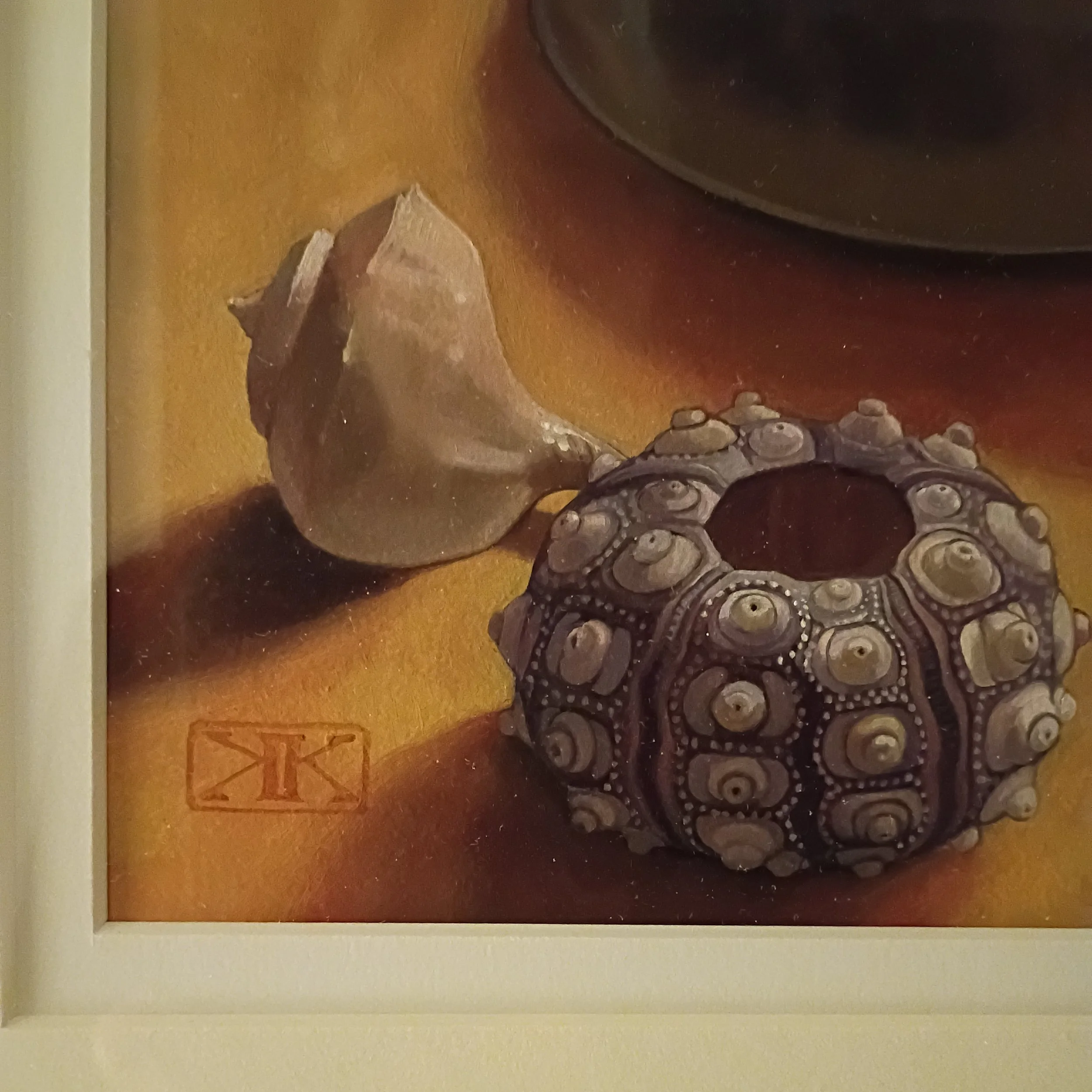
The cartouche on my painting, Marine Biology. This mark held fast for a few decades.
That is, until 2019 when a friend asked whether my pottery had ever been confused with a product of Kim Kardashian's — who, it turns out, uses a back-to-back K trademark on her goods. I had been using my back-to-back K's since well before Miss Kardashian wore a training bra, but I had never trademarked it, imagining that thirty years of published work would protect the sign well enough. The universe, apparently, had other ideas.
I'll admit I was briefly peeved. How dare she. I saw one of her delivery trucks rolling down the road with those back-to-back K's printed in enormous letters on the back, and I was briefly more peeved. Then I thought: cats who find themselves suddenly outdoors don't waste time on self-pity. They go about taking care of themselves — undaunted, undeterred. Obstacles are meant to be surmounted.
I designed a better chop.
The new cartouche: K E S T, two letters above and two below, sometimes inside a square. I use it now on all pottery and sculpture, and as a cartouche on my paintings. It is cleaner, more complete because it has the advantage of telling anyone who encounters it my entire name — no confusion with anyone else, no explanation required.
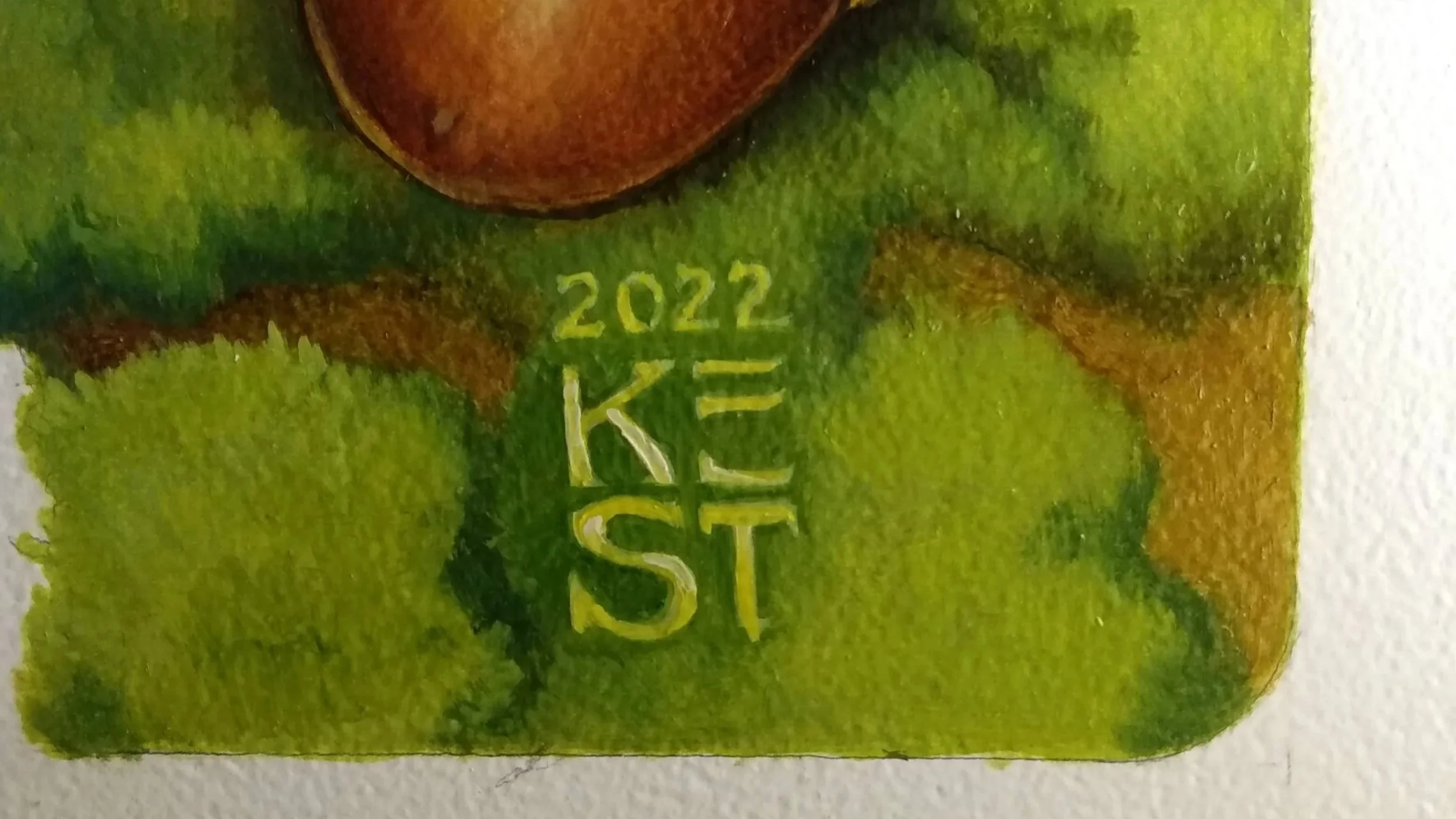
The Kest mark on my painting, Letterlocked.
III. The kestrel
As is my usual way of moving through life, I arrived at the name rather suddenly. I was drawing kestrels one afternoon and made the decision then and there — that would be my new last name. One check of the Lancaster, PA, phone book confirmed it didn't exist locally. I filed the paperwork the following week.
The American kestrel is the smallest falcon in North America — but falcon nonetheless. Not a sparrow that learned some tricks. A raptor, operating at the full capacity of its nature, simply in a more compact form than people expect. The kestrel is also the hovering one: it can hold perfectly still against the wind while it hunts, a fixed point in moving air.
I have seen one hunting exactly once in my entire life. They are resplendently gorgeous — russet and slate, precise and concentrated. That I named myself after a bird I had mostly known from drawings, and that the name turned out to be equally rare and vivid in the world, is something I find quietly satisfying.
Since then, I have seen the name in print, encountered it online, and met a handful of Kests — some of whom seemed genuinely disappointed we weren't related.
Nearly forty years. The name has outlasted the phone book I checked it in, the attorney's office where I paid for it, and at least one K-branded empire.
It's mine. I made it.