
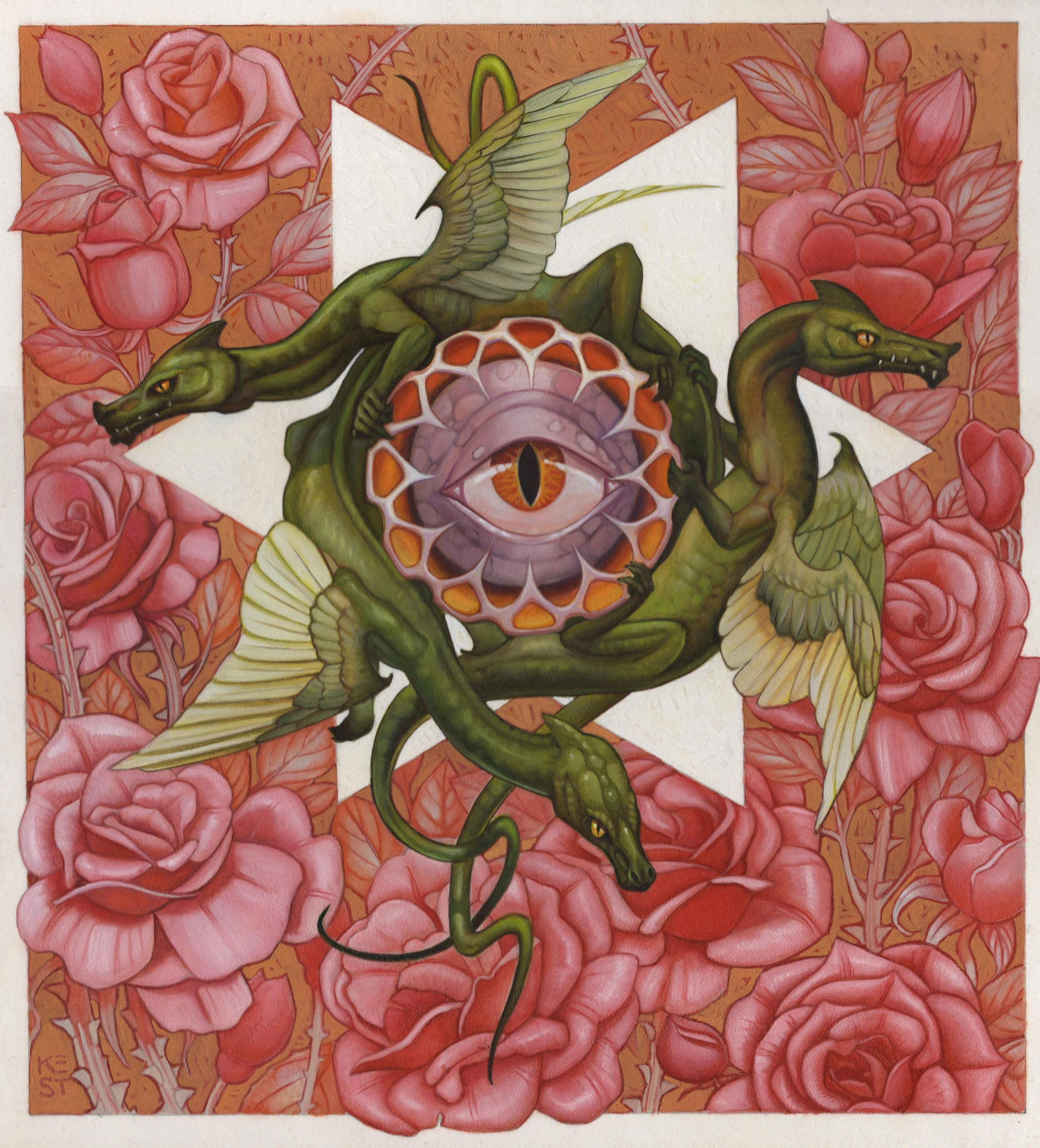
I never had impostor syndrome. Here's what I learned from that.
Over the years I've sat across from a lot of artists — students, colleagues, people whose work I genuinely admired — and watched them tie themselves in knots over questions that went something like this: Am I a real artist if nobody's paying me? Is it too late to start at my age? My work isn't as good as theirs — what's the point? A collector told me my new work is weaker than my old work and I haven't picked up a brush since.
I've counseled, encouraged, argued, and occasionally pleaded. I've pointed to Grandma Moses and Matisse cutting paper from a wheelchair in his eighties. I've talked about Picasso's collectors threatening ruin when he abandoned academic realism — and how he did it anyway. I've said, more times than I can count, that success is in the doing, not in what anyone else decides your work is worth.
It rarely helped. And I've spent a long time wondering why.
Part of the answer, I think, is that I was offering maps to a territory I'd never personally navigated. I don't have impostor syndrome. I want to be honest about that — not to boast, but because that honesty is actually the useful part. Understanding why I was spared it might illuminate something about how the trap is built, and how to avoid stepping into it.
The work's right to exist was never contingent on anyone's opinion of me. I figured that out early, mostly by accident.
I didn't grow up in an encouraging environment. I was female, in a family with no particular interest in difficult art, in a culture that had low expectations for what I might become. Nobody handed me permission. Nobody told me I had a talent that I should seriously pursue. I had doubt in abundance, of course — not about whether I had the right to make work, but about what exactly I wanted to make, where my imagination wanted to go, what my real subject was. There were detours and dead ends. There were years I spent in the wrong genre because I mistook other people's success for a map of my own territory.
But through all of it, something held. Some part of me never confused two things that are easy to confuse: doubt about the work and doubt about my right to make it. I had the first in abundance. The second never quite took hold. And I've only recently understood why.
I wasn't protecting myself. I was protecting the kingdom.
What I mean is this: somewhere early, consciously or not, I made a separation between the work as a living entity with its own right to exist, and myself as its maker. The work wasn't mine to withhold from the world because I wasn't yet credentialed, or validated, or paid, or sufficiently admired. It was mine to steward. To show up for. To get out of the way of. The kingdom — the practice, the body of work, the culture of making — had a sovereignty that didn't depend on whether the queen was universally beloved. My job was to protect that, not to defend my own ego against every slight and comparison and disappointed collector.
This reframe changes everything about the questions that fuel impostor syndrome.
"Is it too late at 75? The kingdom doesn't have an age requirement for citizenship."
Is it too late to start? I hear this from people of every age — twenty-five-year-olds who feel behind their peers, or the seventy-five-year-old who feels like they've missed the window entirely. But this question assumes the destination is what matters. A career, a reputation, a body of work that gets shown in the right places and noticed by the right people. If that's the goal, then yes, timing matters and the anxiety is rational. But if the kingdom is the goal — the sustained, serious act of making, the practice itself — then you can't be late to it. You arrive when you arrive. Grandma Moses began painting in her late seventies. Matisse made some of his most radical work bedridden, with scissors. The work doesn't have an expiration date stamped on the maker.
Am I a real artist if I'm self-taught? The kingdom was never administered by a licensing board. Yes, formal training is genuinely valuable — it gives you tools, problems to wrestle with, a community of people who take the questions seriously, and mentors who can see what you can't see in your own work. I benefited from all of that, eventually. But training confers skills, not legitimacy. Legitimacy — if that word means anything at all — comes from the sustained, serious act of making. From showing up for the work when it's inconvenient, when it's failing, when nobody's watching. A self-taught artist doing that work is more legitimate than a credentialed one who stopped making the moment the grades stopped coming.
What if nobody validates my work? This is the hardest one, and I won't pretend it doesn't sting. Validation is genuinely lovely. I'm not going to tell you it doesn't matter at all, because that would be a lie and you'd know it. But validation is weather. It changes. A collector who loved your old work and finds your new work baffling isn't issuing a verdict — they're reporting their own entry point, their own representational handshake requirements, their own readiness. Picasso's collectors threatened to stop buying when he went Cubist. He lost some of them. The work survived. The kingdom survived. The queen, it turned out, didn't need their particular approval to keep ruling.
What if my trajectory is slower than the artists I admire? Comparison is the oldest trap and the cruelest, because it's always rigged. You're comparing your inside — all the doubt, the failed experiments, the days nothing worked — to someone else's outside — the finished work, the accolades, the visible momentum. You never see their dead ends. You never see the work they destroyed. You're not actually comparing trajectories; you're comparing a map to a myth. The kingdom doesn't have a scoreboard. There's no ranking of whose practice is most advanced. There's only the work in front of you, and whether you showed up for it today.
Every attack on the queen — the comparison, the dismissal, the slow trajectory — is an attempt to destabilize the kingdom. Don't let it.
Here is what I've come to believe, after years of watching the impostor syndrome dragon do its work: every one of these attacks — the absent validation, the disappointed collector, the more-successful peer — is aimed at the same target. They're all trying to convince you that the queen is insufficient, and that therefore the kingdom has no right to exist. The defense isn't to argue that the queen is actually quite competent, thank you very much. That argument never ends. There's always more evidence to be marshaled on both sides, and the dragon is a better lawyer than you are.
The defense is to separate the two entirely. The kingdom's sovereignty doesn't rest on the queen's resume. The work's right to exist doesn't depend on whether you've been validated, or trained, or praised, or paid. It depends on whether you show up for it.
So here is the permission you've been waiting for — and I say this as lovingly as I can say it: stop waiting for it. You were never the one who needed to be granted permission. The work was. And the work has always had it.
The queen serves the kingdom, so pick up your brush.