
During the latter part of this year, I embarked on several new works that seemed to come out of nowhere. When I considered displaying them at IlluXCon, I felt a great deal of trepidation because they struck me as the strangest pieces I’d ever made. They’re anchored in the ceramic tile ideas I began exploring in March and maintain continuity through the apotropaic Eye of Providence as a central motif. Executing them in paint allowed the concept to evolve in ways that aren’t easily achievable in clay. Techniques like translucent layering, diaphanous wings, and subtle gradients come naturally in paint, while clay insists on weight and finality.
What unsettled me wasn’t the imagery itself, but the speed and certainty with which it appeared. These works didn’t negotiate. They insisted. Sigils, by nature, are meant to function rather than explain, and these paintings felt less like illustrations and more like activated objects. They weren’t trying to be decorative or polite. They wanted to do something.
Understanding that shifted how I related to them. These paintings aren’t purely visual objects; they are artworks intended to perform a psychological function. Symbols are not neutral. They are dense carriers of meaning that the psyche recognizes long before language steps in to interpret. These sigil paintings operate in that threshold space, where recognition precedes explanation. In that sense, they are closer to spells than images. They engage the viewer at a level that’s pre-verbal, intuitive, and deeply personal.
I found myself thinking about artists like Hilma af Klint and others who approached art as a means of accessing deeper spiritual and psychological structures. Their work wasn’t concerned with personal expression alone, but with translation: giving form to forces that resist direct articulation. Like them, I’m not interested in closing meaning down. I want these symbols to remain alive, precise enough to be felt, but open enough to shift depending on who encounters them.
That understanding was reinforced during IlluXCon itself. I had several long conversations with attendees about Jungian archetypes and symbolic language, and about the way certain forms recur across cultures and time. One of those conversations introduced me to the Chapel of Sacred Mirrors in Wappingers Falls, New York, a spiritual center where esoteric art forms the core of the experience rather than devotion to a specific godhead. The idea that imagery itself could function as a site of contemplation and transformation felt both novel and strangely familiar.
Calling these works “spell paintings” feels accurate because they are not passive. They aren’t meant to be decoded so much as encountered. Each viewer brings their own internal mythology, fears, and intuitions to the exchange. The paintings meet that material of the mind and activate it. If they succeed, it’s not because they’re intentionally beautiful, but because something subtle shifts in the viewer’s internal landscape.
Showing them at IlluXCon felt like setting unfamiliar instruments on a table and stepping back. I didn’t know how they would be received. To my surprise, people leaned in. Conversations slowed. Several viewers described a sense of recognition rather than interpretation.
These works have clarified something essential for me about medium and intention. Clay resists ethereality; paint allows it to bloom. Rather than replacing my ceramic work, the sigil paintings feel like a parallel current, one that feeds back into the objects and sharpens their charge. They don’t feel like a detour. They feel like an expansion.
I’m carrying these experiences forward as an open inquiry rather than a conclusion. Learning about spaces like the Chapel of Sacred Mirrors has sharpened my curiosity about what it means to center symbolic imagery as a locus of reflection rather than anchoring meaning to a fixed theology. I hope to visit sometime early this year, not in search of answers, but to listen more closely to how images function when they’re allowed to hold the room.
Here are the three which sold at IlluXCon (left to right): Renewal, Abundance, and Remembering What Was Always Meant for You.
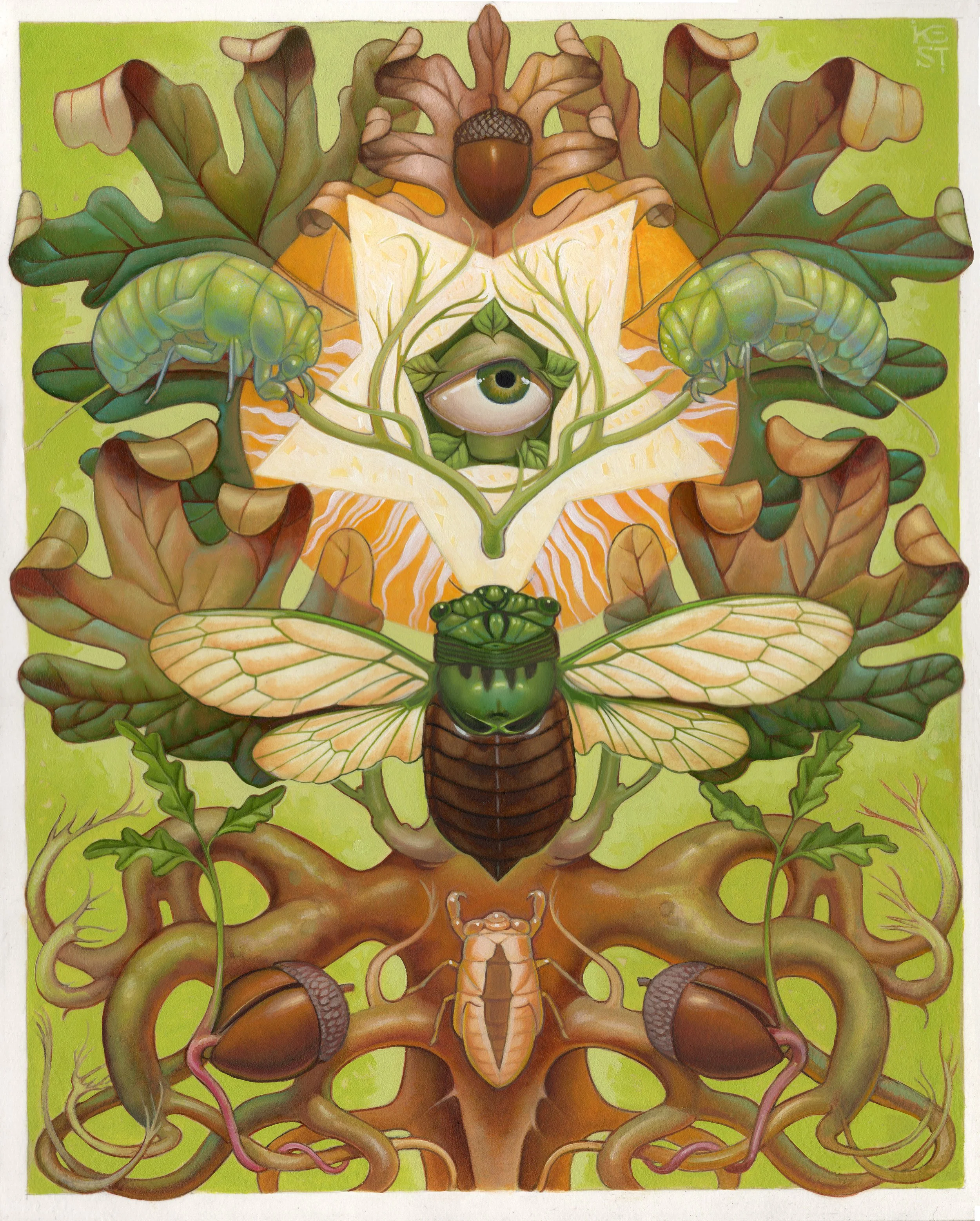
Renewal. Oil on panel, 2025

Abundance. Oil on panel, 2025
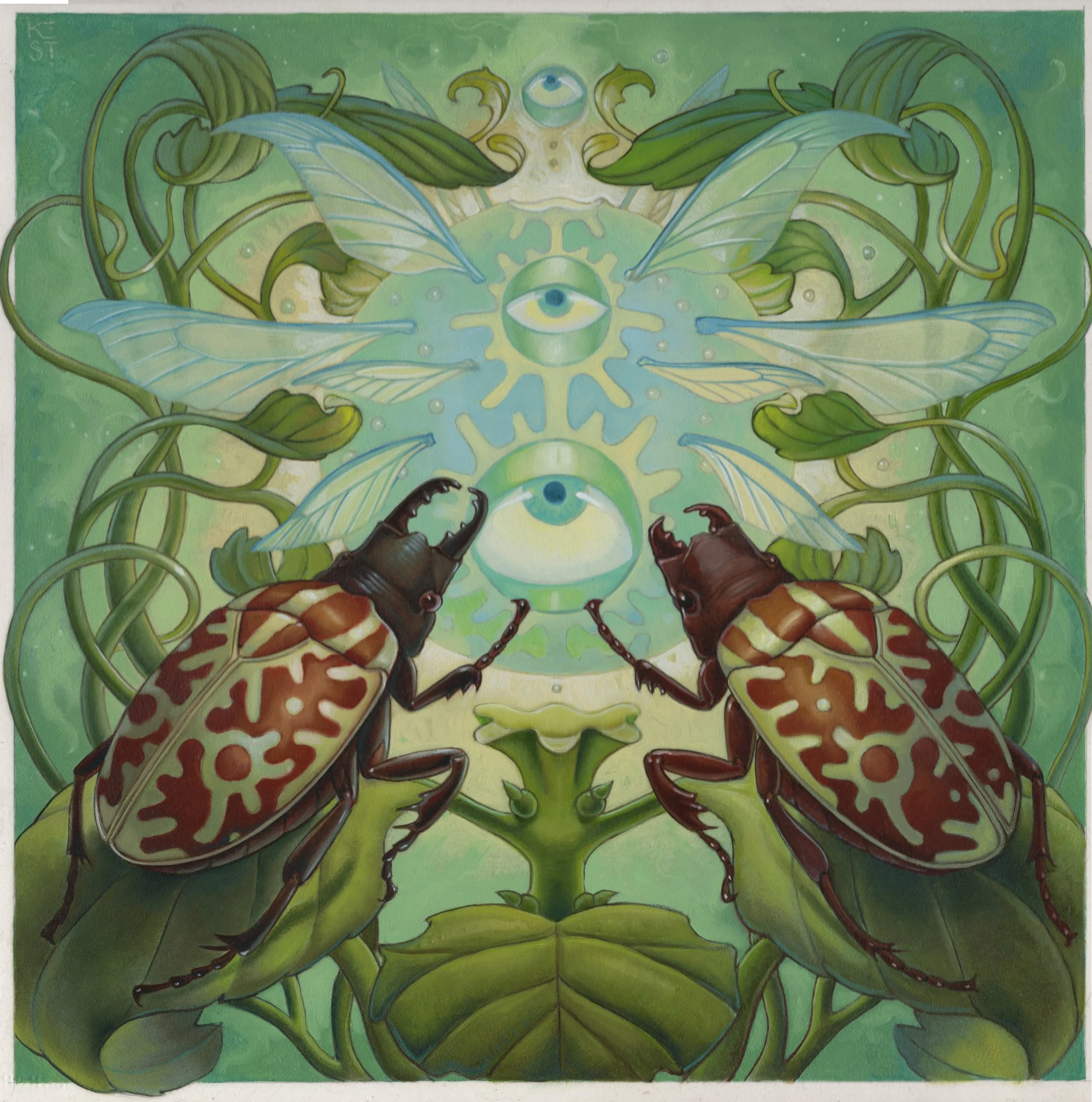
Remembering What Was Always Meant for You. Oil on panel, 2025